


Charles Hardy's Newspaper Clipings- The Eruption of Tarawera
- Greg Austen
- Feb 14
- 3 min read
Updated: Feb 16
When looking through Charles' first book of clippings I came across a copy of a letter he wrote to the New Zealand Herald dated 21 November 1892 headed "A Recent Visit To Wairoa, Lake Tarawera". I had first seen this letter some years ago and recalled it as a very interesting description of the devastation that resulted from the Tarawera Eruption of 1886.
On looking through an earlier section of Charles' book I came across a clipping that was simply headed TUHOTO. Alongside the article was a picture of Tuhoto which described him as The Maori Tohunga (Priest) of Wairoa. The article is not dated but it records that news of the death of Tuhoto had just been received. The article noted that Tuhoto had been a survivor of some 104 hours of being buried under ash at Wairoa at the time of the Tarawera eruption.
Another clipping which is undated but is nearby other articles dated December 1886, has the heading "A Maori On The Deaths At Rotomahana". It also references the tragedy of the Maori and European lives lost as a result of the Tarawera eruption.
On thinking about the eruption I recalled it caused the loss of the great Pink and White Terraces. These were a subject of the great photographic skills of Charles Spencer. Charles Spencer was covered in one of my earlier blogs about the Spencer family who are connected to Charles Hardy's family through his daughter Ada's marriage in 1912 to Edmund Spencer, a brother of Charles Spencer. This blog has arisen from my desire to understand more about the impact of the Tarawera eruption on our ancestors and how Charles Hardy and Charles Spencer were connected to this important piece of New Zealand's history.
Below is a copy of Charles' letter as published in the New Zealand Herald.


At the time of writing this blog I have not established exactly why Charles was travelling on horseback from Auckland all the way to Wairoa and presumably on to another destination. I do know that Mormon missionaries were very active around this time in extending the influence of the Mormon Church into Maori communities in the East Cape area. It is possible that Charles trip was in order to attend a Mormon Church gathering in that area.
I find it interesting that in this article Charles does not include any biblical reference, as was quite usual in much of his writing. Instead he has provided a very clear description of what he and his friends saw and in his last paragraph captured exactly how it made them feel.
By the way Charles is age 60 when he takes on this long horse ride. However given his travels during his early days in Australia and America I expect he considered it to not be a big deal. On horseback or by horse pulled carriage would have been his normal means of travel during most of his lifetime.
Below is a map showing the location of the Buried Village of Te Wairoa and its close proximity to Lake Tarawera.

Tuhoto plays a very interesting part in the story of the Tarawera eruption. Read on and you will find out why.
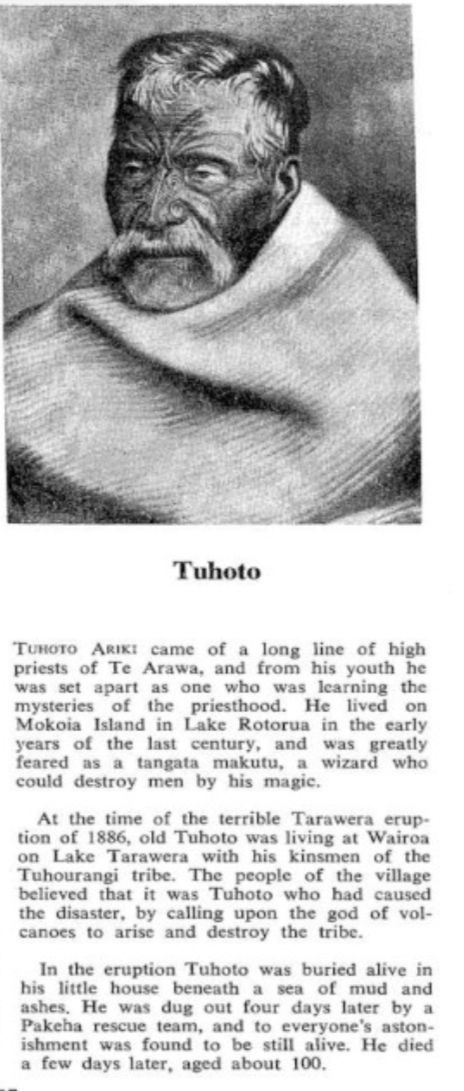
I came across the story below which adds another dimension to Tuhoto. I leave it to you to decide if you consider it to be factual.



Charles Spencer's Photographs of Tarawera

Charles Spencer had photographed Tarawera extensively before the Tarawera eruption. He was selected by geologist James Hector to be a member of a survey party studying the aftermath of the eruption as a result of his prior experience of the area. He took many images. In my opinion the first two below provide the most graphic before and after images.


The famous Pink and White Terraces were sadly lost as a result of the eruption. The image below is "based on" a photograph taken by Charles Spencer. I assume that it a colourised version of a black and white image.

The image below captures the post eruption scene and the party of geologists Charles accompanied.

Below is a selection of Charles Spencer's Tarawera photographs that were published in the Auckland Weekly News in 1931.

Before and after photos of McRaes Hotel.


Below is a link to the excellent NZ ON Screen documentary telling the full story of Tarawera. If you click on the underlined words in blue it should take you to the documentary. It is quite long but in my view worth the time to watch in full.
Watch the Tarawera television documentary (NZ On Screen):


Comments